Base editing (BE) has features that distinguish itself from traditional CRISPR-based applications: high-precision nucleotide-level conversion without inducing double-strand breaks (DSBs). Off-target safety still needs genome-wide nomination, but DSB methods (such as GUIDE-Seq and CHANGE-Seq do not fit base editors, and unenriched whole-genome assays are often not deep enough and not cost-effective.
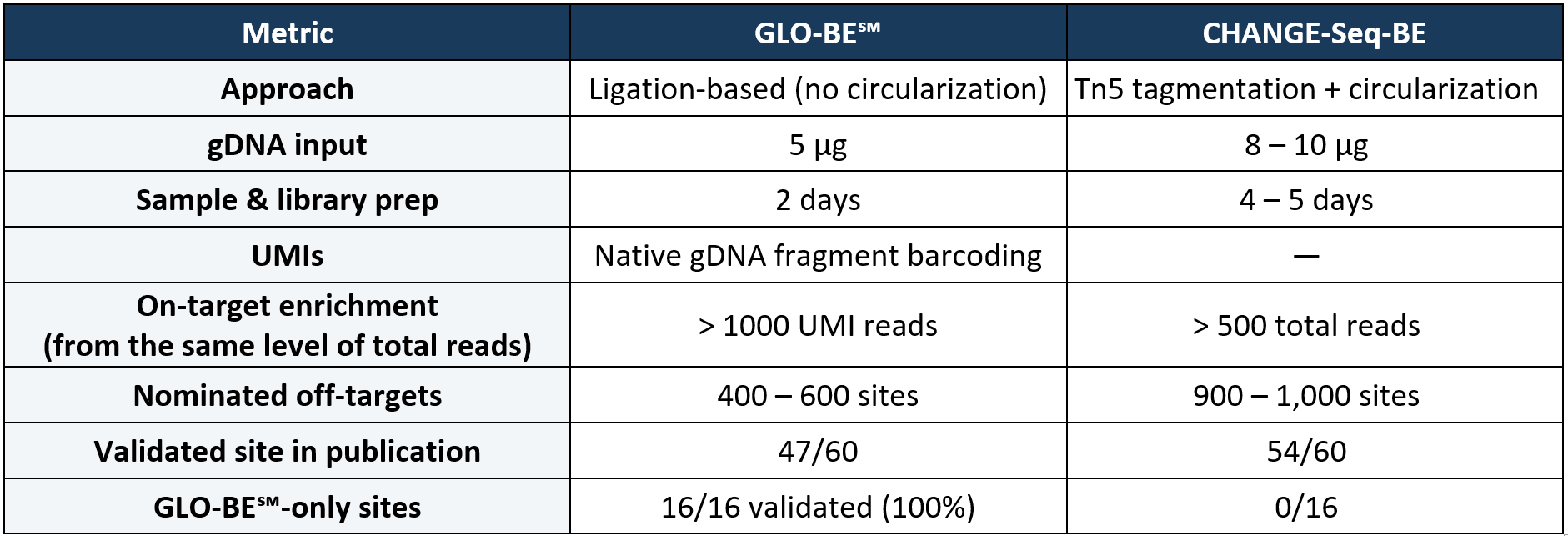
Methods have been developed specifically for evaluating the off-target profiles of base editors, such as CHANGE-Seq-BE through in vitro selection. However, this method relies on DNA circularization, typically needs 8–10 µg gDNA, and takes 4–5 days for sample and library preparation¹˒².
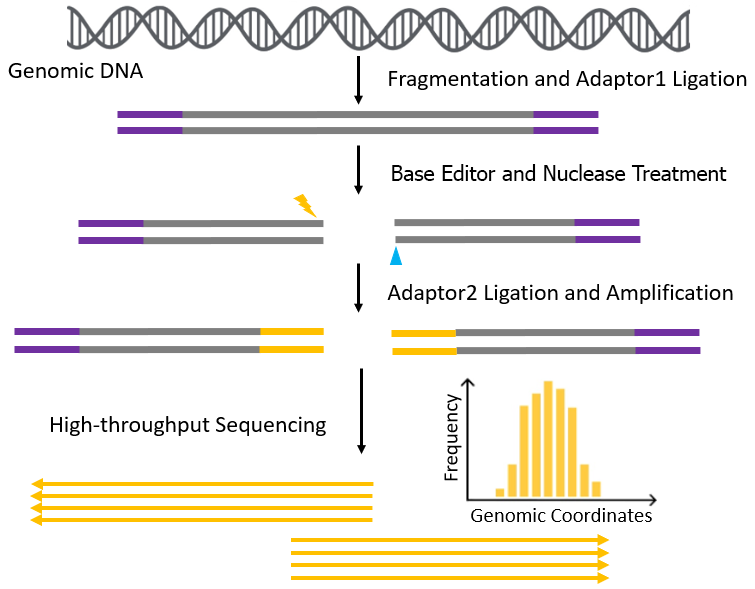
GLO-BE℠ (Genome-Wide Ligation-mediated Off-target Identification for Base Editing) is GeneGoCell’s ligation-based, sample-to-report solution: less gDNA input, UMIs on native gDNA fragments, and a highly effective and efficient 2-day process.
Figure 1. GLO-BE℠ Workflow Illustration
GLO-BE℠ vs. CHANGE-Seq-BE
Side-by-side comparison of operational metrics and CD7 gRNA head-to-head performance:
UMIs on Native Molecules for Confident Quantification
PCR amplification bias is a standing risk in targeted sequencing. GLO-BE℠ introduces UMI barcodes on each native genomic DNA fragment before amplification. This enables sequencing counts to be traceable to native molecules, which reduces PCR bias, lowers false-positive inflation, and supports more accurate characterization of candidate off-target sites.
Higher On-Target Efficiency
GLO-BE℠ datasets have been generated across multiple independent runs, yielding consistent outputs.
On-target and off-target profiling was conducted using the same CD7 gRNA used in the CHANGE-Seq-BE publication². The on-target read count in GLO-BE℠ is >1,000 UMI reads, versus >500 non-UMI reads in CHANGE-Seq-BE. The on-target enrichment rate is approximately one-fold higher than CHANGE-Seq-BE.
In GLO-BE℠ runs, the ratio of on-target reads to UMI reads ranged from 0.005% to 0.007%. CHANGE-Seq-BE reports on-target reads at about 0.003% of total reads (no UMI reported in the publication) under the comparison conditions used.
Higher Off-Target Discovery Efficiency
Off-target profiling
CHANGE-Seq-BE nominated roughly 900–1,000 CD7 gRNA off-target sites, while GLO-BE℠ using the same gRNA returned a more refined list of approximately 400–600 nominated sites.
Capture of Validated Sites Reported in the Publication
Among 60 experimentally validated off-target sites for this target:
- CHANGE-Seq-BE captured 54 of 60, among approximately 900–1,000 total nominated off-target sites.
- GLO-BE℠ captured 47 of 60, among approximately 400–600 total nominated off-target sites.
This shows that the validated off-target site detection by GLO-BE℠ is more efficient than CHANGE-Seq-BE.
Difference in Editing System
Despite the effort to use the same reagents as those in the published CHANGE-Seq-BE study,² technical variation is still present due to batch-to-batch reagent differences and lab-to-lab operational differences.
While most validated off-target sites showed similar editing profiles, technical variation did result in noticeable differences.
For example, OT 05 was reported to have an off-target editing rate of over 35%. However, in the GeneGoCell laboratory, the same site showed <2% off-target editing.
Sites Missed by GLO-BE℠
The top five validated sites, based on the published editing rate,² that were missed by GLO-BE℠ were analyzed using GeneGoCell’s high-precision editing verification G-Amp℠ platform.
Three of the five showed A→G substitution below background noise level, consistent with expected technical variation between different experimental settings, despite the use of identical reagents to those used in the publication.
Novel-Site Validation
Furthermore, 16 candidate off-target sites detected uniquely by GLO-BE℠ (missed by CHANGE-Seq-BE) were selected randomly from various signal-level bins ranging from high to low for experimental validation.
Using the G-Amp℠ platform, base editing was detected at 16 of 16 sites, with editing frequencies ranging from 62.04% to 0.95%.
References
-
Lazzarotto CR, et al. CHANGE-seq reveals genetic and epigenetic effects on CRISPR–Cas9 genome-wide activity. Nature Biotechnology. 2020;38:1317–1327.
-
Lazzarotto CR, Katta V, Li Y, et al. Sensitive and unbiased genome-wide profiling of base-editor-induced off-target activity using CHANGE-seq-BE. Nature Biotechnology. 2026.
About GeneGoCell
GeneGoCell is a CLIA/CDPH-certified, GxP-compliant, ISO/IEC 17025:2017-accredited laboratory based in San Diego, focusing on Genome Editing Verification (GEV℠).
For a complimentary SME consultation on GLO-BE℠:
Email: info@genegocell.com
Website: https://genegocell.com
GeneGoCell: Compliant. Customized. Responsive. Fast.
Disclaimer: All Rights Reserved. Content © GeneGoCell, Inc. unless stated otherwise. GeneGoCell is a CLIA & CDPH-certified, ISO/IEC 17025:2017-accredited, GxP-compliant (CFR Title 21 Part 58) NGS testing facility.